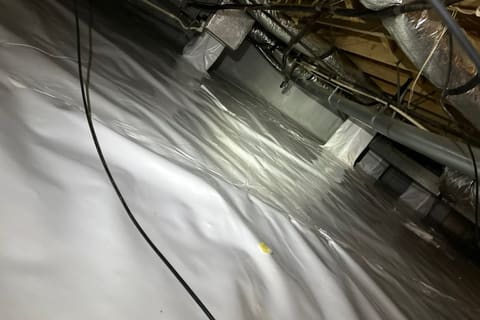
Yes, as long as it goes in the right place. In Atlanta, fiberglass batts stapled between the floor joists of a vented crawl space tend to fail: humid summer air comes in through the vents, condenses on the cool subfloor and ductwork, and the wet fiberglass sags, grows mold and ends up lying on the dirt. The setup that holds up in our climate is a sealed crawl space, with a vapor barrier on the ground, rigid foam on the foundation walls and rim joists, and a dehumidifier keeping the air dry.
If your house is a 1950s brick ranch in Tucker or a 1920s bungalow in Kirkwood, there's a decent chance the insulation under your floor is doing more harm than good right now. Here's how to tell, and what a proper fix involves.
What affects a crawl space insulation job
| Factor | Why it matters | How much it changes the job |
|---|---|---|
| Condition of the old insulation | Wet, moldy or fallen batts have to be pulled, bagged and hauled out before anything new goes in | Moderate to high, depending on how much is down |
| Where the water is coming from | Insulating over a moisture problem just hides it. Clogged gutters, downspouts dumping at the foundation and red clay graded toward the house all need sorting first | High if you need an interior French drain or sump pump |
| Vented or sealed crawl space | Wall insulation only works once the vents are closed and the space is sealed | Decides the whole approach |
| Crawl height and access | A walk-in crawl under a Brookhaven split-level is a different day than 16 inches of clearance under an East Atlanta bungalow | Labor time |
| Foundation wall type | Brick curtain walls, hollow block and poured concrete each take foam and sealant differently | Low to moderate |
| Rim joist condition | Rotted or termite-damaged band boards get repaired before foam covers them up | Varies with what we find |
| Wall perimeter | Wall insulation is measured along the foundation, not by floor square footage | Scales with the size of the house |
| Structural issues | Sagging floors or cracked walls get fixed before the space is sealed | Adds drop girders, interior steel columns, crack injection or carbon-fiber straps |
Why floor batts fail under Atlanta houses
Most older crawl spaces around here were built vented, on the theory that outside air would dry them out. That works in a dry climate. In Atlanta, July air often carries a dew point around 70 degrees. When that air drifts through the foundation vents and touches a subfloor cooled by your air conditioning, or a supply duct running in the 50s, it condenses. Fiberglass is very good at holding onto that water.
Once batts get wet they lose most of their insulating value, get heavy and drop out of the joist bays. The paper facing grows mold. Mice and rats move into whatever cavities are left. And because warm air rises through a house, some of the air you breathe upstairs started out in the crawl space. That's usually where the musty smell in a hall closet comes from.
When we open the access door on an older vented crawl, the usual sight is batts hanging by a few wire supports, a torn plastic sheet that doesn't reach the walls, and damp red clay underneath.
Where the insulation should go instead
In a sealed (encapsulated) crawl space, the insulation moves from the floor to the foundation walls. The crawl becomes part of the house's conditioned space instead of a damp cellar under it. Here's what that job looks like, in order:
- Fix the moisture first. That means gutters and grading outside, and an interior French drain to a sump pump if water still comes through the walls.
- Close and seal the vents.
- Lay a heavy reinforced vapor barrier on the ground, run it up the foundation walls, and seal it at the seams and around the masonry support columns.
- Fasten and seal rigid foam board to the foundation walls. Most foam needs an approved ignition barrier or has to be a product rated for exposed crawl space use, and the inspector will check.
- Seal and insulate the rim joists with cut-to-fit foam or spray foam. In an older house the rim joist is one of the leakiest spots in the whole envelope.
- Install a dehumidifier sized for the space, draining to the sump or outside.
One detail people miss: leave a termite inspection strip at the top of the foundation wall so your pest company can still see the sill plate. They'll ask about it. We repair termite damage and seal wildlife entry points, but treatment stays with your termite company, and we work around their schedule.
When floor insulation still makes sense
Sometimes sealing the crawl isn't in the cards yet. Maybe you're still chasing a drainage problem, or the house is about to go on the market. In that case you can insulate the floor properly: unfaced batts or rigid foam held tight against the subfloor (not drooping on a few wires), with a ground vapor barrier underneath. Just know it's a stopgap. A vented crawl in this climate pulls in wet air every summer, and that floor insulation will be fighting it the whole time.
Signs your crawl space insulation has already failed
- Batts lying on the ground or hanging loose from the joists
- A musty smell in closets or bedrooms over the crawl, worst in July and August
- Cold floors over the den or kitchen in January
- Hardwood boards cupping at the edges
- Black or green spots on the paper facing
- Droppings or tunnels through the insulation
If you're seeing two or more of these, the insulation is usually the symptom and moisture is the cause.
What it costs
We don't publish one number, because the factors in the table above swing the price more than the insulation itself does. A dry crawl with good access and a sound rim joist is a short, straightforward job. A wet crawl with fallen batts, a drainage problem and some rotted band boards is a bigger project, and most of that cost is the moisture and wood repair, not the foam. Whoever quotes you should break it out line by line: tear-out, vapor barrier, wall foam, rim joists, dehumidifier, and any drainage or structural work. If you get one lump number, ask for the breakdown.
November is a good month to look. The crawl is cooler to work in, and you'll know what you're dealing with before next summer's humidity shows up. If you want someone to go under the house and show you photos of what's actually down there, start with our crawl space services.